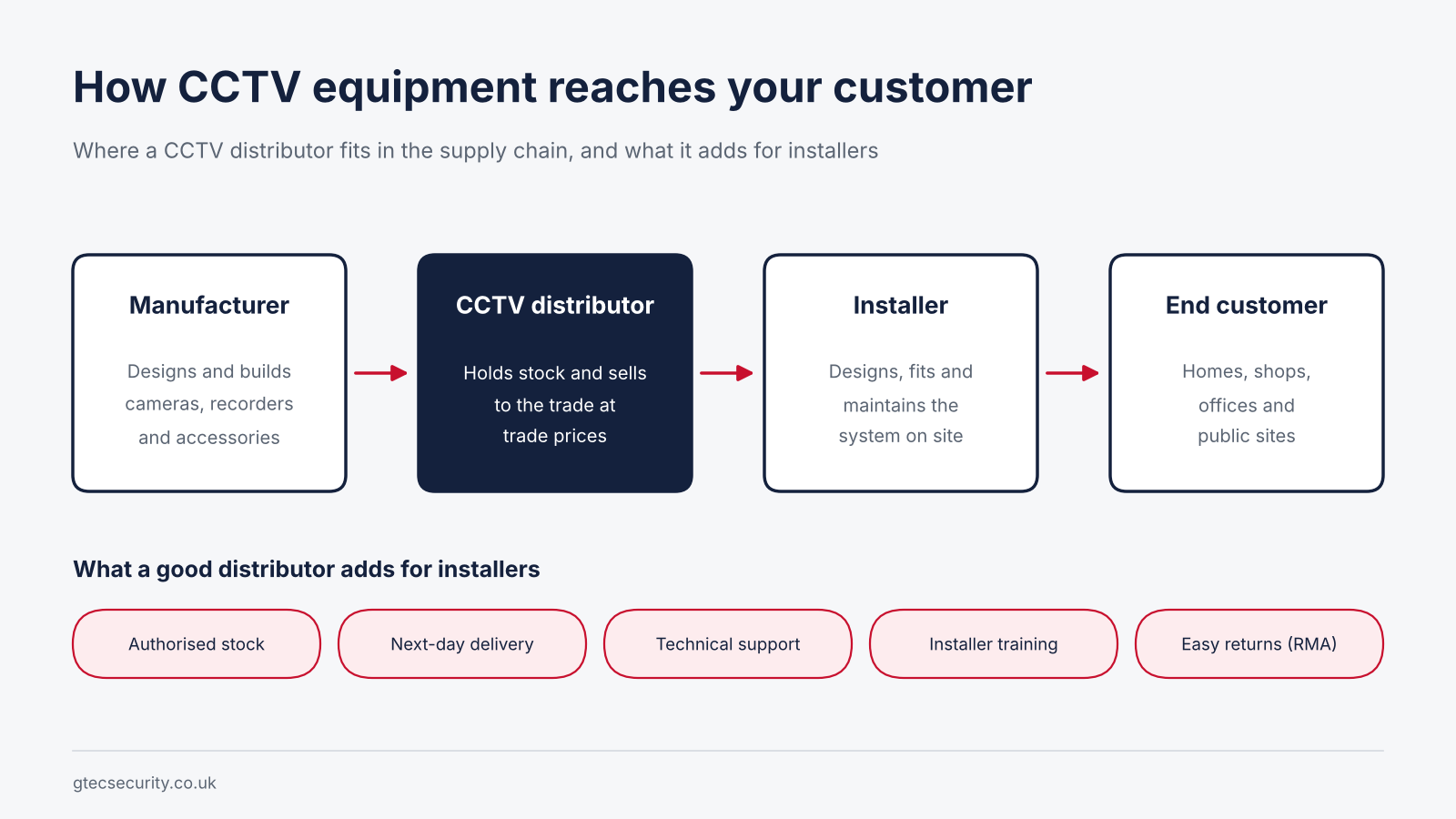
A good CCTV distributor gives installers four things: trade prices, reliable stock from trusted brands, fast delivery and expert technical help. When you choose a wholesale CCTV supplier, check that they are authorised for the brands you install, keep stock ready for next-day dispatch, offer trade credit, and back you up with training and after-sales support.
What to look for at a glance:
- Authorised partner for leading CCTV brands
- Deep stock of cameras, recorders and accessories
- Clear trade pricing and credit accounts
- Next-day delivery or trade counter collection
- Technical support from people who understand installs
- Training to keep your skills up to date
- A simple warranty and returns process
Picking the right supplier is one of the biggest decisions a security installer makes. The wrong one can leave you waiting for parts, stuck with faulty kit or paying more than you should. The right one helps you finish jobs on time and grow your business.
At G-TEC, we have supplied professional security installers since 2002. In that time, we have seen what separates a good CCTV wholesaler from a poor one. This guide shares what we have learned, so you can choose with confidence.
What Does a CCTV Distributor Do?
A CCTV distributor buys security cameras and equipment directly from manufacturers in large amounts. It then sells this stock to installers, integrators and resellers at trade prices.
Good distributors do much more than ship boxes. They hold stock, give product advice, handle warranty claims and pass on firmware updates and training from the brands they work with. In short, they link the manufacturer and the installer and keep the supply chain running smoothly.
Our Lasted Products
Why Your Choice of CCTV Supplier Matters
Your customers judge you on the system you fit. If a camera fails after a month, they call you, not the manufacturer. That is why the supplier behind your kit matters so much.
A reliable supplier helps you:
- Win more quotes with fair trade pricing
- Finish jobs on time because parts are in stock
- Avoid callbacks by fitting genuine, tested products
- Solve problems faster with expert technical help
Trade Distributor vs Online Marketplace vs Buying Direct
Installers usually have three ways to buy CCTV equipment. Here is how they compare:
For most installers, a trade distributor gives the best mix of price, speed and support.
7 Things to Look for in a Wholesale CCTV Supplier
1. Authorised Partnerships with Trusted Brands
Always check that your supplier is an authorised partner for the brands you install. Authorised stock comes with a full manufacturer warranty, the correct firmware and proper support if something goes wrong. Grey imports may look cheaper, but they can cause warranty and update problems later.
For example, we are a National Approved Distributor for SERAGE and an authorised Hikvision partner. Not sure which brand suits your next job? Read our guide on Hikvision vs SERAGE.
2. Stock Levels You Can Rely On
An empty shelf costs you time and money. A strong CCTV distributor keeps deep stock of the whole system, not just cameras. That includes recorders, hard drives, cables, power supplies and accessories.
Ready-made complete CCTV system bundles can also save you time when quoting smaller jobs.
3. Clear Trade Pricing and Credit Options
Trade pricing should be simple to see and easy to compare. Look for a supplier that shows your account prices online and offers credit terms once you are established. This helps you manage cash flow on bigger projects.
You can open a trade account online, then apply for a credit account when you are ready.
4. Fast Delivery and Trade Counter Collection
When a job is booked for tomorrow, you need kit fast. Check delivery times, order cut-off times and delivery costs before you commit.
We offer next-day delivery nationwide across the UK, same-day delivery for many local customers, and free delivery on orders over £200 + VAT. Installers in and around west London can also use Click & Collect from our Hounslow trade counter.
5. Real Technical Support
Good support means speaking to someone who understands installs. They should help you choose the right lens, plan PoE power budgets, size storage and fix set-up problems.
Our technical team helps with product selection, system design and project support. For specialist jobs, our guide to ANPR cameras explains when number plate recognition is worth adding.
6. Training That Keeps You Ahead
Security technology changes fast, and the best suppliers help you keep up. Through our training academy, we run CCTV Level 1 and Level 2 courses, plus manufacturer-led training on CCTV, intruder alarms, fire and networking. It suits both experienced engineers and people new to the trade.
7. Simple After-Sales and Returns
Even good products fail sometimes. A clear returns process gets your customer back up and running quickly. Before you buy, read the supplier's returns and RMA process so you know what to expect.
Technical Insight: Planning Kit for an 8-Camera Job
Here is the kind of check a good distributor's technical team will run with you before you order. Take a typical job: eight 4MP IP cameras on an 8-channel PoE recorder, recording 24/7 for 30 days.
Check the PoE Power Budget
A 4MP camera often draws around 5–7 watts, and more when infrared or heaters are on. Eight cameras can need up to about 56 W. Add around 25% headroom, and you want a recorder or switch with a PoE budget of at least 70 W. Always check each camera's datasheet, as PTZ cameras need far more power.
Work Out the Storage
At around 4 Mbps per camera using H.265, each camera records roughly 43 GB a day. Eight cameras need about 350 GB a day, or around 10.4 TB for 30 days. A 12 TB surveillance hard drive gives you room to spare. Motion-only recording can cut this a lot.
Keep Cable Runs Under 100 Metres
Standard Ethernet runs must stay under 100 metres. For longer distances, plan a PoE extender, a wireless bridge or an Ethernet-over-coax converter.
Getting these numbers right before you order avoids return visits and unhappy customers.
Red Flags to Watch Out For
Some suppliers look good on price but let you down later. Watch out for these warning signs:
- No proof of authorised status. Ask for it, or check the manufacturer's own partner list.
- Stock that is always "on order". If items are rarely in stock, your jobs will be delayed.
- Prices far below everyone else. This can mean grey imports, old models or no warranty.
- No phone number or trade counter. You need real people when a job goes wrong.
- No clear returns or RMA process. Faulty kit should be easy to send back.
- No help after the sale. A supplier who disappears once you pay is not a partner.
One red flag is a reason to ask questions. Two or more is a reason to look elsewhere.
Questions to Ask Before Opening a Trade Account
- Are you an authorised distributor for the brands I use?
- What stock do you hold, and what is your delivery cut-off time?
- Do you offer credit terms for trade customers?
- Can I speak to a technical expert before I buy?
- Do you provide installer training?
- How do warranty claims and returns work?
If a supplier cannot answer these clearly, keep looking.
How G-TEC Supports Security Installers
For more than 24 years, we have worked with installers across the UK on everything from single home systems to large commercial projects. In reviews on our website, Lions Security Systems, a customer for nearly 10 years, praise our prices, helpful staff and aftersales support. 1 Secure – Techno Dimensions Ltd says simply: “Their support & training is exceptional.”
Because we stock more than CCTV, you can source a whole project from one place. That includes intruder alarms, fire detection, access control and networking. Fewer suppliers means fewer invoices, fewer deliveries and less admin.
Frequently Asked Questions
What is the difference between a CCTV distributor and a CCTV wholesaler?
A distributor usually buys directly from manufacturers and often holds official brand partnerships. A wholesaler sells in bulk to the trade and may buy its stock from distributors. Many suppliers, including us, do both.
Do I need a trade account to buy from a CCTV wholesaler?
Most wholesale suppliers sell to trade customers only. A trade account gives you access to trade prices, special offers and, in many cases, credit terms.
How do I open a trade account with a CCTV distributor?
Most distributors ask you to fill in a short online form with your business details. With us, you can register for a trade account online. To pay on account, complete our credit application form. Credit applications are processed within 2 working days.
Can a CCTV distributor help me design a system?
Yes. A good distributor will help you choose cameras, recorders, storage and cabling to match the site and your customer's budget.
How quickly can I get CCTV equipment delivered?
Most trade suppliers offer next-day delivery. Some, like us, also offer same-day local delivery and trade counter collection.
Find the Right CCTV Distributor for Your Business
Choosing a supplier is about more than price. Look for authorised brands, solid stock, fast delivery, expert advice and real after-sales support.
If you want a partner that ticks every box, register for a G-TEC trade account today. You can also request a catalogue, book a visit from our team, or contact us on 020 8898 9500.